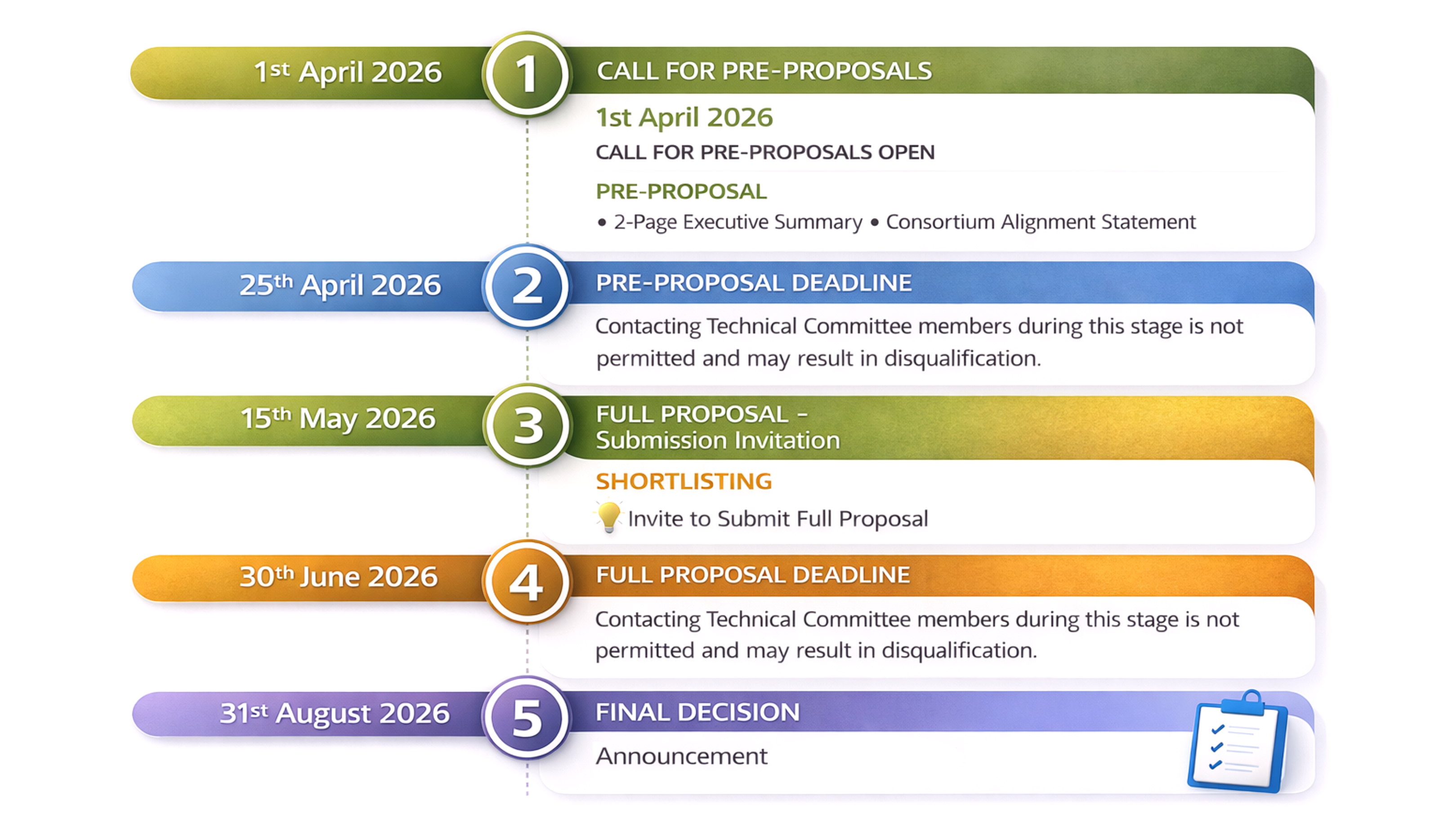
KEY DATES
- Applications Open: 1 April 2026
- Submission Deadline: 25 April 2026
- Shortlisting / Invitation to Full Proposal: 15 May 2026
- Full Proposal Submission Deadline: 30 June 2026
- Final Decision Announcement: 31 August 2026
CONSORTIUM OVERVIEW
The KFUPM Consortium for a Sustainable Future is a collaborative research platform that brings together KFUPM and leading industry partners to address critical sustainability challenges. The consortium funds and manages research projects that deliver measurable sustainability impact and support technology development toward real-world deployment.
Consortium members are participating entities from industry, government, and academia that formally join the Consortium through executed agreements and provide financial and/or in-kind contributions to support its objectives. Members contribute strategic input and actively participate in project evaluation, prioritization, governance structures and oversight. In return, members are granted defined access and usage rights to research outputs and intellectual property in accordance with the Consortium Agreement.
The current consortium members are:
- Saudi Aramco
- Saudi Water Authority
- Research Development and Innovation Authority (RDIA)
- Oil Sustainability Program (OSP)
- Sipchem (Sahara International Petrochemicals Company)
PURPOSE
The KFUPM Consortium for a Sustainable Future invites proposals for Generic Research Projects (GRPs) and Directed Research Projects (DRPs) that address key challenges across the circular carbon economy, environmental sustainability, critical minerals, and energy transition enabling technologies through materials discovery and utilization. Proposals must demonstrate measurable sustainability impact and a credible pathway to deployment, industry adoption, or strategic value to consortium members.
- Generic Research Projects (GRPs): GRPs are intended to address shared consortium challenges and generate outcomes of broad relevance to consortium members.
- Directed Research Projects (DRPs): DRPs are intended to address specific member-driven needs while remaining consistent with the consortium’s overall objectives and thematic scope. DRPs should identify the sponsoring member(s), the strategic need being addressed, and the proposed pathway to execution under project-specific terms.
*Applicants may apply for consideration under one or both categories (GRP and DRP).
CONSORTIUM SCOPE & PRIORITY THEMES
Projects must clearly align with one or more of the consortium’s scope themes. Examples include, but are not limited to:
- Water & Environment: wastewater treatment, water quality management, membrane technologies, water harvesting, pipeline leak detection/mitigation, and constructed wetlands.
- Carbon Management: carbon capture (air / flue gas / seawater), CO2 conversion and utilization, and enabling materials.
- Energy transition enabling technologies & materials: renewable energy generation, electrification, energy conversion, and storage solutions that support the decarbonization of energy systems and reduce environmental impact.
- Critical minerals: securing and sustaining critical mineral supply for future technologies.
- Circular Economy: redesigning materials and advancing innovative technologies that enable continuous resource circulation and minimize waste.
TRL POSITIONING (Required)
The consortium welcomes both low- and high-TRL proposals. Every proposal must state:
- Starting TRL
- Target TRL
- Plan to advance TRL with evidence-based milestones
- For DRPs, the TRL plan should also reflect the intended member use case, validation environment, or deployment pathway.
FUNDING & DURATION
- Project duration: up to 3 years (continuation beyond each review period is subject to satisfactory progress).
- Budget guidance: Up to SAR 600,000 for GRPs and SAR 1.0 million for DRPs.
ELIGIBILITY
- Applicants must be KFUPM faculty members or research scientists.
- Multi-IRC and cross-departmental teams are encouraged.
- DRPs should identify the relevant sponsoring member(s) or intended member champion, where applicable.
PROPOSAL CONTENT
At this stage, applicants are required to submit only the pre-proposal (Stage I). The full proposal (Stage II) will be submitted only upon invitation. Pre-proposals must be submitted using the Consortium Pre-proposal Template by 25 April 2026.
- Indication of project type: GRP or DRP (applicants may indicate one or request consideration under both categories, subject to review and alignment)
- Problem Statement & Relevance
- Proposed Solution / Innovation
- Methodology
- Expected Outcomes and Impact (benefits to consortium members and stakeholders)
- TRL Baseline and Advancement Plan
- Team & Capability
Stage II: Full Proposal (submitted upon invitation)
- Summary & Background
- Project Objectives (Three bullet points and should be clear and measurable)
- State-of-the-Art (add a summary table of relevant literature)
- Workplan: tasks, milestones, deliverables, and measurable KPIs
- Expected Outcomes & Impact
- Commercial Potential & TRL Advancement Plan
- Risk Assessment & Mitigation Plan.
- Budget & Justification.
- Background IP Declaration (as applicable).
- For DRPs: proposed execution model and member involvement.
EVALUATION CRITERIA
- GRPs: reviewed, ranked, and recommended through the consortium’s standard generic project governance process.
- DRPs: selected by a consortium member and assessed by the Consortium director for alignment with consortium objectives, member priorities, technical feasibility, and compliance with applicable Directed Research Project arrangements.
| Score Band | Description |
| A – Outstanding (9–10) | World-class concept with strong novelty, high impact potential, and clear pathway to deployment. |
| B – Excellent (7–8) | High-quality proposal with strong scientific and strategic merit. |
| C – Very Good (5–6) | Sound concept but some aspects require strengthening. |
| D – Good (3–4) | Technically plausible but lacks clear innovation or impact. |
| E – Uncompetitive (1–2) | Major weaknesses or insufficient relevance to consortium priorities. |
STAGE 1 – PRE-PROPOSAL ASSESSMENT
(Shortlisting stage for invitation to full proposal)
Purpose: Rapid screening to identify proposals aligned with consortium priorities and with strong potential for impact.
Assessment Criteria and Weighting
| Criterion | Weight | Evaluation Focus |
| Strategic Alignment with Consortium Priorities | 25% | Alignment with consortium themes such as carbon management, water systems, critical minerals, energy transition, and materials innovation. Contribution to the circular carbon economy and relevance to member needs. |
| Novelty & Value Proposition | 25% | Clarity of the challenge addressed and the novelty of the proposed solution. Potential to address a major gap in knowledge or technology. |
| TRL Position & Advancement Plan | 20% | Starting TRL and credibility of the pathway to advance TRL during the project. Evidence of clearly defined milestones demonstrating progress in technology maturity. |
| Team Capability & Collaboration Potential | 15% | PI expertise and ability to deliver the research. Evidence of cross-disciplinary collaboration or industry engagement. |
| Potential Impact & Industry Relevance | 15% | Potential environmental, economic, or technological impact. Relevance to industry stakeholders or consortium members. For DRPs, direct strategic value to sponsoring member(s) should be assessed. |
Pre-Proposal Outcome is based on the following weighted scores:
| Total Score | Decision |
| ≥ 8.0 | Invite Full Proposal |
| 6.0 – 7.9 | Invite with revisions |
| < 6.0 | Do Not Invite |
STAGE 2 – FULL PROPOSAL ASSESSMENT
(Detailed technical evaluation for funding decision)
Purpose: Comprehensive evaluation of scientific merit, feasibility, and deployment potential.
Assessment Criteria and Weighting
| Criterion | Weight | Evaluation Focus |
| Technical Quality & Scientific Rigor | 25% | Clarity of hypotheses and research questions, soundness of methods, and robustness of project design. |
| Sustainability Alignment & Strategic Impact | 20% | Contribution to circular carbon economy, clean energy, water sustainability, or environmental solutions. Alignment with consortium mission and national priorities. |
| Innovation & Advancement Beyond State-of-the-Art | 15% | Degree of novelty and differentiation from existing solutions. Clear positioning against the state-of-the-art and ability to address a meaningful gap. |
| TRL Advancement & Deliverability | 15% | Credibility of the pathway from current TRL to target TRL, including defined milestones, validation activities, or prototype development. |
| Feasibility & Risk Management | 15% | Quality of project plan, risk, mitigation strategies, availability of facilities and expertise, and likelihood of timely delivery. |
| Budget Justification & Feasibility | 5% | Alignment of budget with workplan, justification of major cost items, and efficient use of consortium resources. |
| Team Capability & Collaboration Strength | 5% | PI and team expertise, track record, and ability to deliver. Evidence of interdisciplinary collaboration or engagement with industry or consortium members. |
Additional Evaluation Considerations
Reviewers should also consider:
- Budget & Value for Money
- Budget appropriateness relative to project scope
- Efficient use of consortium or sponsoring-member funding
2. Intellectual Property
- Clear declaration of Background IP
- Potential for resulting IP aligned with consortium agreement and project type
3. Collaboration
- Engagement with consortium members
- Cross-IRC or multi-departmental collaboration
- For DRPs, clarity of sponsoring member engagement and execution roles
How to Apply
To apply, please provide proposal information and upload the required document through the following link by 25 April 2026.
Supporting Documents
kindly find below, the supporting documents:
Notes
- The full proposal (Stage II) will be submitted only upon invitation. At this stage, applicants are required to submit only the pre-proposal (Stage I). Selected applicants will be invited to proceed with the full proposal submission.
- This call is intentionally structured to accommodate both Generic Research Projects and Directed Research Projects. Where a Directed Research Project proceeds, detailed execution, contracting, funding structure, and IP treatment shall follow the applicable consortium agreement provisions and project-specific arrangements.
- Applicants MUST NOT contact members of the Technical Committee or the Consortium Director during the review and evaluation process.
- Enquiries: For technical questions regarding the application process, please contact irc-am@kfupm.edu.sa
TIMELINE